
Selecting the right humidity control technology starts with understanding the application—not the equipment. Required dew point, ventilation rates, moisture loads, available utilities, and energy goals all influence the best solution.
This guide provides a high-level comparison of common humidification and dehumidification technologies. Use the interactive graphics below to explore each technology’s typical operating range, applications, advantages, and limitations.
Typical Dew Point Range:
55-50°F
Best For:
Advantages:
Limitations:
Products:
Typical Dew Point Range:
50-43°F
Best For:
Advantages:
Products:
Typical Dew Point Range:
52-42°F
Best For:
Advantages:
Products:
Typical Dew Point Range:
45–32°F
Best For:
Advantages:
Products:
Typical Dew Point Range:
40–0°F
Best For:
Advantages:
Products:
Typical Dew Point Range:
0°F to -150°F dew point
Best For:
Common Applications:
Advantages:
Limitations:
Products:
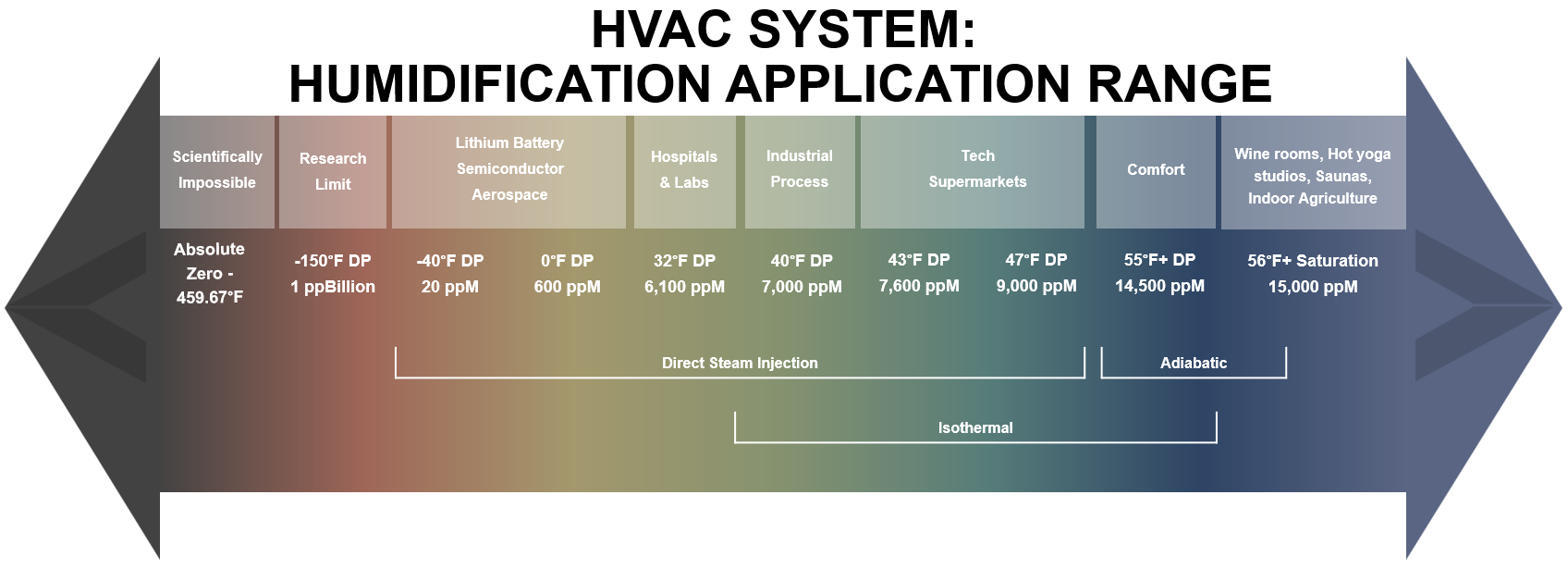
Before selecting equipment, define:
Once these design criteria are established, use the technology guides above and below to compare solutions.
Typical Capacity:
Medium to High
Typical Humidification Method:
Evaporative (non-steam)
Best For:
Common Applications:
Advantages:
Limitations:
Products:
Typical Capacity:
High
Typical Humidification Method:
Boiler steam
Best For:
Common Applications:
Advantages:
Limitations:
Products:
Typical Capacity:
Low to High
Typical Humidification Method:
Self-generated steam
Best For:
Common Applications:
Advantages:
Limitations:
Products:
Different building types have very different humidity requirements.
Dew point—not just relative humidity—determines which technologies are capable of meeting the design conditions.
Outdoor air, occupancy, and process loads often drive equipment selection more than sensible cooling.
Steam availability, chilled water, and water quality can eliminate or favor certain technologies.
The lowest first cost is not always the lowest life-cycle cost.
Maintenance access, water treatment, and component replacement should be considered early in design.