
Equipment selection establishes what an airside system can do. Controls, installation, commissioning, and maintenance determine how much of that performance actually survives.
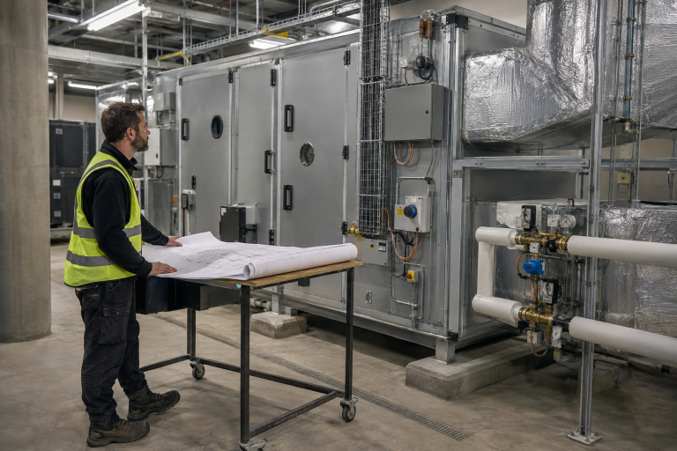
Design intent becomes real in the space between the drawings, the installed system, and the people expected to operate it.
A fan can be selected correctly and still disappoint in the field.
The scheduled airflow can be right. The static pressure can be right. The efficiency can be right. The coil can meet capacity. The damper can meet the leakage requirement.
Then all of those individually correct pieces get installed in an actual building.
A tight elbow lands too close to a fan inlet. Duct transitions don’t look quite like they did on paper. A sensor moves because the original location is inaccessible. A sequence gets interpreted differently than the engineer expected. Someone overrides a point during startup and nobody remembers to put it back.
Airside systems don’t usually lose performance because of one spectacular mistake. More often, they lose it a little at a time.
One decision affects another. A field condition creates a workaround. The workaround changes how controls need to behave. The new sequence solves one problem but creates another operating condition nobody tests because the weather isn’t cooperating on commissioning day.
By occupancy, every individual decision may have been perfectly defensible. The trouble is that buildings do not experience those decisions individually. They experience the system they create together.
Consider something as fundamental as fan performance.
A fan selection is based on more than airflow and static pressure. It also assumes the fan will be installed with inlet and outlet conditions that allow it to perform reasonably close to its tested rating.
That assumption can unravel when the physical installation is developed. The mechanical room gets tighter. Ductwork competes with structure, piping, and electrical systems. A transition is shortened during coordination. An elbow moves closer to the fan after value engineering or an equipment substitution. In the field, an installer makes the geometry fit the space available.
Each decision may be understandable on its own. Together, they can change the airflow entering or leaving the fan.
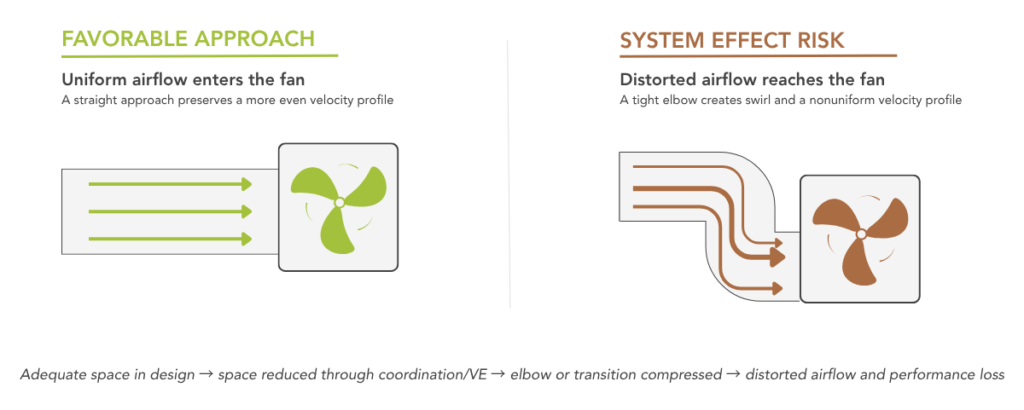
AMCA calls the resulting performance loss system effect. The fan may still be the correct model, and the scheduled values may still look correct, but the installed system no longer matches the conditions on which that selection was based.
This is why preserving design intent requires more than selecting the right fan. The design must provide enough space for the fan to perform—or explicitly account for the penalty when ideal inlet and outlet conditions cannot be maintained.
Controls cannot recover that lost geometry. A VFD can increase fan speed, but it may do so at the cost of energy, noise, and equipment stress. It cannot straighten distorted airflow or restore a transition that disappeared during construction.
Same fan selection. Different approach conditions. Different installed performance.
A VFD can change fan speed. A static pressure reset can reduce unnecessary fan energy. A good sequence can respond intelligently to changing demand.
The same principle applies throughout an airside system.

Poor transitions, elbows, obstructions, or uneven airflow near the fan can change what the installed system is capable of delivering compared with the conditions used to establish fan performance.
A coil isn’t only a capacity number. Its selection affects pressure drop, approach, controllability, maintenance access, and how the system behaves at part load.
A damper isn’t simply an item on a schedule. Leakage, sizing, actuator selection, authority, and installation all influence how accurately the system can control airflow.
A sensor doesn’t become useful simply because it appears on a controls drawing. It has to measure conditions that actually represent what you’re trying to control.
This is why designing for long-term operation has to begin before controls ever arrive on the job.
Eventually, the drawings have to become decisions.
OPEN THIS DAMPER / RESET THIS PRESSURE / RAMP THIS FAN / ENABLE THE ECONOMIZER / GENERATE AN ALARM
That’s what makes controls such an important handoff. The sequence of operation is where engineering intent becomes actual building behavior. Small ambiguities here can have surprisingly long lives.
Installing a VFD creates the ability to vary fan speed, but that doesn’t automatically mean the system will operate efficiently. The sequence still has to tell the system when and why pressure should change. The same is true of supply-air temperature reset, economizer control, demand-controlled ventilation, humidity control, and alarms.
A good control sequence shouldn’t require the next programmer, commissioning agent, or facility engineer to reverse-engineer what the designer meant.
Those answers shouldn’t live only in the head of the person who designed the system.
ASHRAE Guideline 36 was developed around standardized high-performance HVAC sequences intended to improve efficiency, control stability, and fault detection. It is useful not because every building should be programmed identically, but because it demonstrates what happens when sequences are treated as an engineering discipline instead of an afterthought.
One of the best things a project team can do is bring controls into these conversations early enough to ask uncomfortable questions while they are still inexpensive to answer.
That conversation is far easier during design than after someone is standing in front of a running air handler trying to program around the answer.
A fan spinning in the correct direction proves that a fan can spin in the correct direction. It does not prove the system works.
Does the component respond?
Does the complete system behave correctly?
Command actuator → actuator moves
Test operating modes, changing demand, sensor failure, alarm response, and performance over time
One device at one moment
Interactions across different conditions
Imagine commissioning an economizer during a week when outdoor conditions never require full economizer operation. The actuator moves. The point changes on the graphic. The minimum position looks reasonable. Everyone checks a box.
Three months later, the first favorable morning arrives and the dampers finally have to travel through their full range. That is when someone discovers the linkage problem, the sensor problem, or the control loop nobody had an opportunity to watch under actual operating conditions.
The same thing can happen with occupancy schedules, pressure resets, supply-air temperature reset, demand-controlled ventilation, staging, humidity control, and alarms. A system can pass a snapshot test and still behave badly across a year.
Berkeley Lab’s large commissioning meta-analysis evaluated hundreds of new and existing buildings and found meaningful energy and non-energy benefits from commissioning. Earlier work also found that more comprehensive commissioning produced considerably greater savings than less-thorough efforts.
Commissioning isn’t valuable because someone completed a checklist. It is valuable because somebody went looking for the gap between what the building was supposed to do and what it was actually doing.
Mechanical rooms are remarkably spacious before they’re built. Then come the ducts, piping, conduit, valves, panels, and the one piece of equipment someone swears wasn’t shown there when the access door was coordinated.
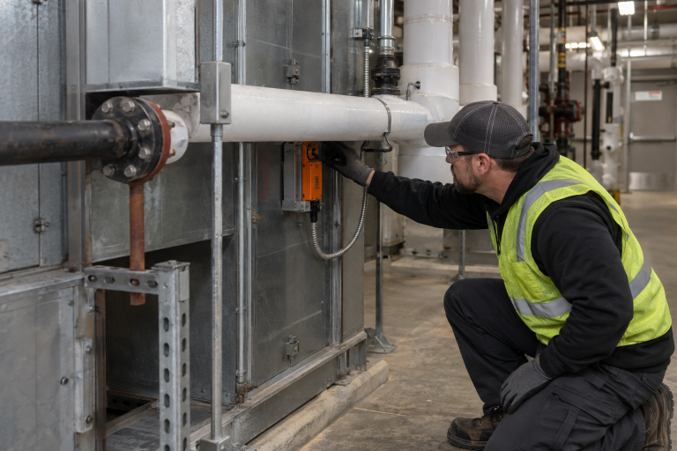
Nobody remembers how clean the installation looked during turnover. They remember the actuator buried behind piping. The filter that can’t come out without being bent. The coil that no one can get a brush into. The sensor that technically can be calibrated if you’re willing to become a contortionist.
And they definitely remember the BAS graphic that provides hundreds of pieces of information while somehow avoiding the one thing they need to know:
These sound like inconveniences. Over twenty years, they become performance problems.
It accumulates: one dirty coil, one overridden point, one failed sensor, one disabled alarm, one sequence somebody stopped trusting.
Airside optimization is often discussed as something we do to an existing building: find the problem, tune the sequence, reset the pressure, correct the airflow, change the schedule, clean the coil, fix the damper.
Those things matter. But some of the best optimization work happens years earlier, when the project team makes it less likely that those problems will develop in the first place.
Does the installation give the fan a reasonable chance of performing the way it was selected to perform?
Did we consider what happens at part load, not simply whether it meets peak capacity?
Does the sequence clearly explain how the system should respond as conditions change?
Can we demonstrate those operating modes before turnover, or at least trend and verify them when conditions allow?
Can someone maintain the thing without fighting everything installed around it?
These aren’t separate conversations. They’re the same conversation at different points in the building’s life.
Before a project leaves design, imagine the documents landing on three desks.
Will this meet the performance requirements?
Can I make the system behave this way?
Can I keep the system behaving that way?
The first question gets a lot of attention.
Long-term performance depends on all three.
The first question gets a lot of attention. Long-term performance depends on all three.
Design intent isn’t preserved by the specification sitting in a project folder. It is preserved through thousands of small decisions made by the people who inherit that specification afterward.
Twenty years from now, that may matter considerably more than how good the mechanical room looked on turnover day. So, if you do one thing, talk to the facilities team if you can. Find out what matters to them or what struggles they’ve run into that they’d like to avoid in the future.
If there isn’t a team in place, take the extra moment to get feedback from a mechanical contractor or service provider that you trust. Chances are that they will have insights that will not just benefit the owner but will bolster you and your career for years to come.
Airside performance doesn’t stop with controls, commissioning, or serviceability. Fan selection and system effect, coil performance, leakage, reset strategies, sensor location, controls, and maintenance all interact. Sometimes the smallest decision in one part of the system creates a surprisingly large consequence somewhere else.
Explore practical ways to improve airside performance from design through operation.
Register:

AMCA Publication 201 Fans and Systems
ASHRAE Guideline 36 High Performance Sequences of Operation for HVAC Systems
https://www.ashrae.org/news/ashraejournal/guideline-36-2021-what-s-new-and-why-it-s-important
Berkeley Lab Building Commissioning Costs and Savings Across Three Decades
https://bies.lbl.gov/publications/building-commissioning-costs-and